
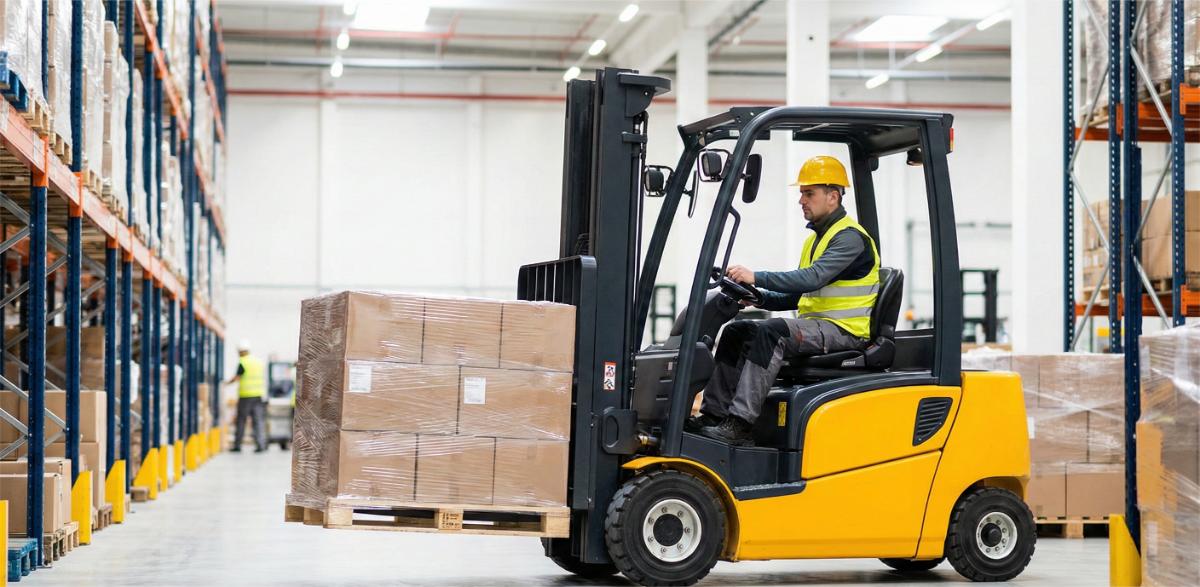
To read a forklift load chart for any load height and load center, match three things: (1) your load center or the distance to the load’s center of gravity, (2) your lift height, and (3) the chart’s listed capacity for that exact combination.
If your load center moves out or your forks go higher, the allowable weight drops. That matters because forklift incidents are not rare. The National Institute for Occupational Safety and Health (NIOSH) reports that nearly 100 U.S. workers are killed each year and another 20,000 are seriously injured in forklift-related incidents.
For businesses shopping used fork trucks, this is a buying issue as much as an operator issue.
Table of Contents
Key Takeaways
✔ Match load center + lift height to the chart value.
✔ Higher lifts and longer load centers cut capacity.
✔ Trust the data plate for capacity and forklift weight.
✔ Attachments often reduce rated capacity.
✔ Buy used fork trucks only with verified plate data.
What Is Forklift Load Capacity?
Forklift capacity is not a single “max” number. It is a rated weight at a specific load center and under specific conditions (including mast configuration and attachments). The Occupational Safety and Health Administration (OSHA) explains that forklifts are designed around a standard load center, commonly 24 inches, assuming an evenly distributed load on a standard pallet.
For practical reading, treat forklift capacity as conditional:
- Rated capacity: The number on the nameplate for a defined lift height and load center.
- Usable capacity: The number after you account for load shape, load center, lift height, and attachments.
How Much Can a Forklift Lift? Understanding Capacity Limits
Forklift capacity isn’t just a single number—it changes based on the load’s center of gravity and the lift height.
OSHA’s stability guidance notes that most trucks of 30,000 pounds capacity or less are normally rated at a 24-inch load center. Move the load’s center of gravity farther out and you increase the forward tipping force, like sliding a weight toward the end of a seesaw.
A reliable rule for reading charts is simple:
- Higher lift height = Lower allowable load
- Longer load center = Lower allowable load
- Added attachments = Lower allowable load
This is also why “how much weight can a forklift lift” is a chart question, not a guess. The chart is the forklift’s safety math, already done.
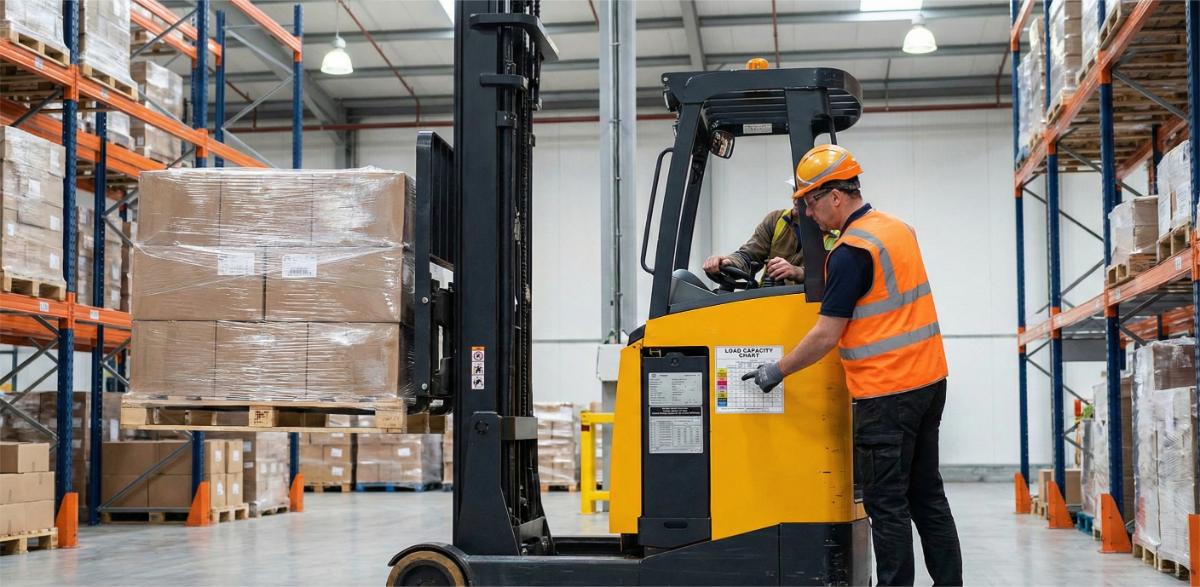
How Much Does a Forklift Weigh and Why It Matters
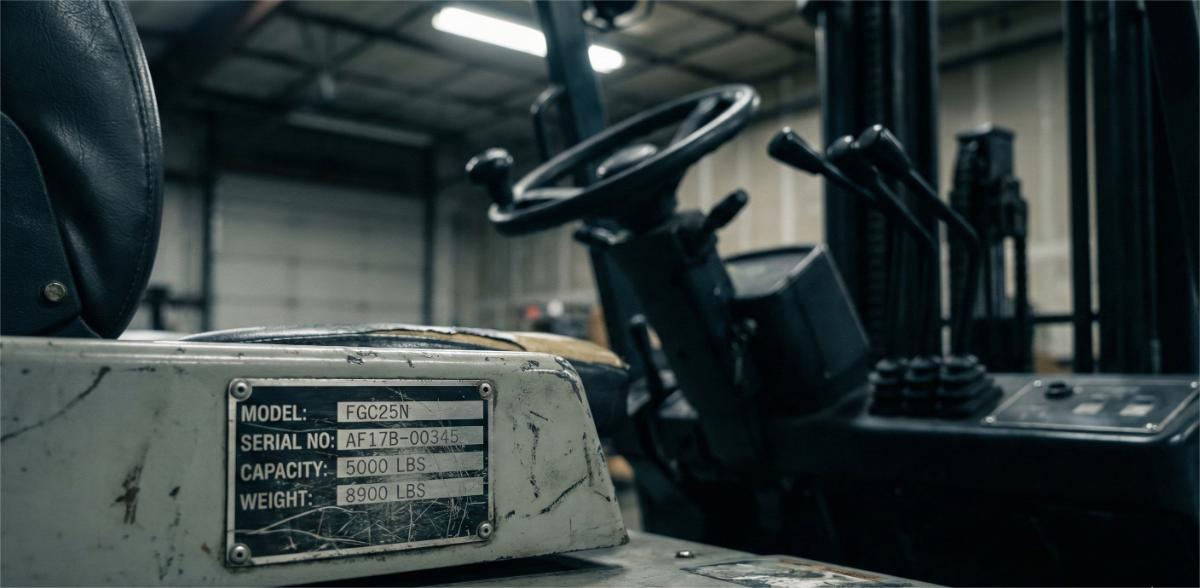
Forklift weight matters for floor loading, transport permits, dock plate limits, and trailer planning. Instead of guessing, start with the most reliable source: the forklift’s nameplate (data plate) on that exact unit.
For a concrete reference point, OSHA’s nameplate example shows a truck weight of 8,680 pounds for a forklift rated 5,000 pounds at a 24-inch load center to a maximum height of 130 inches.
Businesses need to know how much a forklift weighs for the following reasons:
- Floor and slab limits: Heavier trucks raise point loads.
- Dock and trailer capacity: Truck weight plus load weight can exceed equipment ratings.
- Stability: Counterbalance designs depend on forklift weight distribution.
Forklift Sizes and Dimensions and Their Impact on Load Charts
Forklift load charts do not exist in a vacuum. Forklift sizes and forklift dimensions shape what you can safely handle, and whether you can even position the truck correctly.
Key ways forklift sizes affect chart performance:
- Wheelbase and counterweight influence stability margins.
- Mast type and overall height affect lift capability and visibility.
- Fork length and carriage affect load positioning and load center.
Key ways forklift dimensions affect operations:
- Aisle width fit: If the truck must approach at an angle, the load center effectively shifts.
- Rack interaction: Higher lifts amplify small positioning errors.
- Load placement: Mis-centering on forks increases instability.
In other words, forklift sizes and forklift dimensions do not just determine where the truck fits. They influence whether you can consistently keep loads at the chart’s assumptions.
What Is a Forklift Data Plate?
The data plate (nameplate) is your quickest path to reality. It’s essential for understanding a truck’s capabilities and limitations, including capacity and forklift weight.
A data plate commonly includes:
- Rated capacity at a stated load center
- Maximum lift height tied to that rating
- Attachment information (if equipped)
- Truck weight and fuel type
If the plate is missing, unreadable, or clearly outdated, treat that as a safety and compliance issue, not a minor annoyance.
How to Read a Forklift Load Capacity Chart Step by Step
Step 1: Identify the Rated Load Center
The load center is the distance from the face of the forks to the load’s center of gravity.
What to do in the field:
- Measure the load depth (front to back).
- Estimate the center of gravity as roughly half the depth for evenly distributed loads.
- Compare that distance to the load center(s) listed on the chart.
If your load center is larger than the chart’s base rating, the chart should show reduced capacity. If it does not, you need the correct plate or chart for that configuration.
Step 2: Match the Lift Height You Actually Use
Load charts often list capacities at different lift heights or mast stages. Your safest approach is to match:
- The height of the pick
- The height of travel (if traveling with load raised is unavoidable)
- The height of placement into racking
Capacity can change as you extend the mast. Use the line or row that matches your working height, not your best-case height.
Step 3: Read the Intersection and Use That Number
Once you have the correct load center and lift height, read the allowable load at that intersection. That is the true answer to:
- How much can a forklift lift for this job?
- How much weight can a forklift lift at this load center and height?
- The working forklift capacity under your conditions
If your load weight is unknown, do not “round down and hope.” Weigh it or get verified shipping weights.
Quick Facts
|
✔ Most ratings assume a 24-inch load center for common trucks. ✔ The nameplate lists the truck’s rated capacity and often the forklift weight. ✔ Attachments can reduce capacity and require updated plates/markings. |
How Attachments Change Forklift Capacity
Attachments commonly shift the load farther forward, add weight, and change handling. OSHA requires that modifications and additions affecting capacity and safe operation not be performed without the manufacturer’s prior written approval, and that capacity and instruction plates/tags/decals be changed accordingly.
Practical implications for businesses:
- Side shifters and clamps often reduce forklift capacity.
- Fork extensions can increase load center and reduce allowable load.
- Any attachment means you must verify the updated chart or plate is present and legible.
If you are evaluating used fork trucks, attachment history is not optional. It affects what the truck can safely lift today.
How Forklift Load Capacities Are Regulated
In the U.S., OSHA’s powered industrial truck standard drives many workplace requirements, including rules on modifications and updated markings.
Industry safety standards are also maintained through the ANSI/ITSDF B56 series. ITSDF publishes B56 standards, including B56.1, which covers safety requirements for low and high lift trucks.
OSHA is enforcement, and ANSI/ITSDF standards inform how manufacturers and programs define safe design and practice. Your daily decision point is still the same: operate within the rated capacity on the plate for the truck as configured.
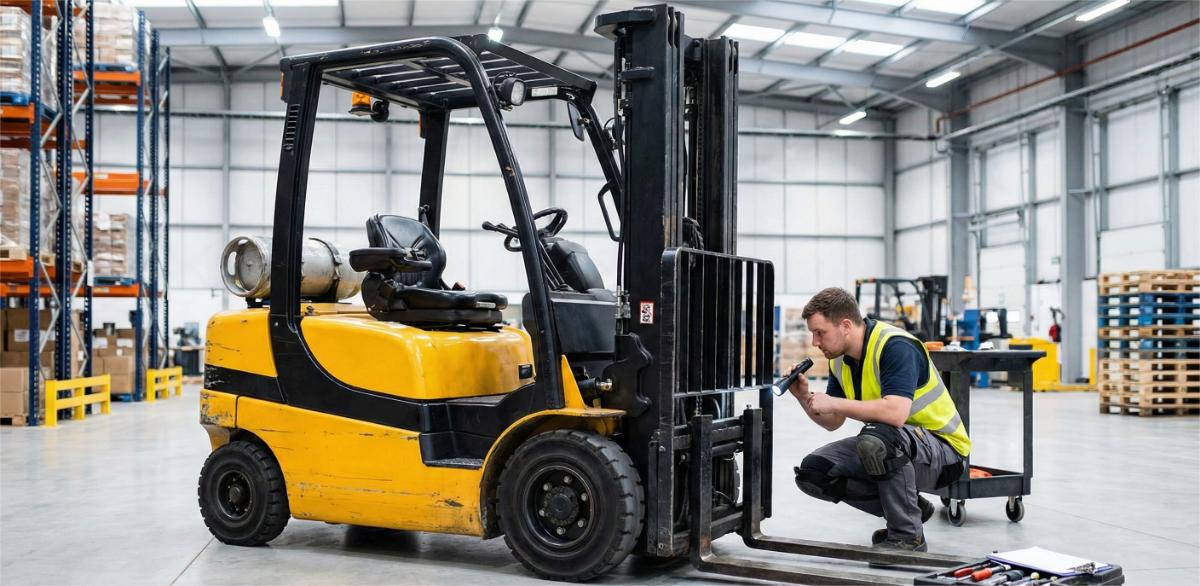
Used Fork Trucks: What to Check Before You Buy
Used fork trucks can be a smart financial move, but only if capacity documentation matches the truck as it sits on your floor.
What to verify before purchase:
- The data plate is present, readable, and matches the truck (model, serial, configuration).
- Any attachments are listed and reflected in updated capacity markings.
- Lift height and mast type match your racking needs.
- Fork condition and carriage fit support safe load positioning.
- Forklift weight is known for transport, docks, and floor loading.
If a seller cannot support the truck’s current forklift capacity with proper markings, assume your risk increases and your usable capacity may be lower than advertised.
Best Practices for Managing Forklift Load Capacity in Business Operations
These practices help businesses reduce capacity-related mistakes, protect equipment, and keep operators working within the forklift’s rated limits, even when loads, lift heights, or attachments change.
- Train operators to read the nameplate and load chart every time the job changes.
- Standardize load measurement so load center and load weight are known.
- Keep loads low and stable during travel and avoid raising loads unless necessary.
- Plan for future needs by selecting forklift capacity above your typical loads, not equal to them.
- Audit attachments and markings so updated plates are in place after changes.
Frequently Asked Questions (FAQs)
How to calculate forklift load capacity at different heights?
Use the load moment from the data plate, then adjust for your actual load center.
Load moment = Rated capacity × Rated load center
Example: 3,000 lb × 24 in = 72,000 in-lb
Adjusted capacity = Load moment ÷ Actual load center
72,000 ÷ 30 in = 2,400 lb
How to interpret a load chart?
Read it like a “matching” chart:
- Find your lift height (how high you need to raise the load).
- Find your load center (how far the load’s center of gravity sits from the fork face).
- Use the intersection value as the maximum allowable weight for that exact setup.
How to calculate load for a forklift?
Compute the truck’s maximum allowable moment, then compare it to your load.
- Maximum moment = Rated capacity × Rated load center
- Your load moment = Actual load weight × Actual load center
How to determine load center?
Check the data plate for the rated load center (often 24 inches). Then find the load’s center of gravity, usually halfway through the load depth if it’s evenly distributed, and measure from the fork face to that point. That distance is your actual load center.
What does 24 load center mean?
It means the forklift’s rated capacity assumes the load’s center of gravity is 24 inches from the fork face, typical for an evenly loaded 48-inch-deep pallet. If the center of gravity sits farther out, the usable capacity drops.
Choose the Right Forklift Setup With Almeida Forklifts
Reading a forklift load chart comes down to one habit: match your lift height and load center to the chart, then treat that number as the limit.
If your team is sizing equipment, comparing trucks, or confirming how much does a forklift weigh for transport or facility planning, Almeida Forklifts can help. We’ll match your real loads to the right forklift weight, forklift capacity, and configuration for operations in and around Lauderdale Lakes, FL.
Contact us today!