
Table of Contents
Key Takeaways
✔ Match capacity, inspect and test the unit, plan full ownership costs, verify the dealer, and choose the right mast to avoid expensive mistakes.
✔ Toyota is most often seen as the reliability leader, with Crown, Hyster, Yale, and Mitsubishi/CAT also strong choices.
✔ Keep a 3-foot safety buffer from people or obstacles and stop if that space is crossed.
✔ Only trained operators should drive, follow load limits, keep loads low, and never use unsafe equipment.
✔ Buy forklifts for sale only when capacity, mast, condition, dealer support, performance, and long-term costs fit the job.
A forklift purchase can make a facility faster and safer—or quietly turn into a budget leak and a safety risk. Across warehouses, yards, and job sites in the U.S., the difference usually comes down to whether the buyer avoided a handful of predictable mistakes. The smartest purchasers don’t chase the lowest price; they match the machine to the job, verify its condition, and plan for real ownership costs.
Here are the seven most common slip-ups people make when shopping forklifts for sale, plus the safety and reliability basics that separate a “good deal” from a costly regret.
7 Mistakes to Avoid When Buying a Forklift for Sale
Mistake #1 — Failing To Match Capacity To The Job
Choosing a forklift with insufficient capacity is one of the most costly and dangerous errors a buyer can make. Underestimating weight, height, or attachment impact can lead to equipment damage, safety risks, and regulatory violations.
Why Capacity Matters
Forklifts for sale capacity aren’t flexible—it’s a strict limit based on the load center and lift configuration. Choosing “just enough” capacity can backfire, especially as loads change or grow.
- Average vs. peak loads: Consider both typical pallet weights and the heaviest loads handled during peak times.
- Attachment impact: Tools like clamps, rotators, or side shifters reduce usable capacity by shifting the load center.
- Load charts: These manufacturer-published references define safe handling at different lift heights and should guide all purchase decisions.
- OSHA compliance: Operating outside rated capacity violates federal regulations and increases the chance of accidents or tip-overs.
Mistake #2 — Skipping A Pre-Purchase Inspection
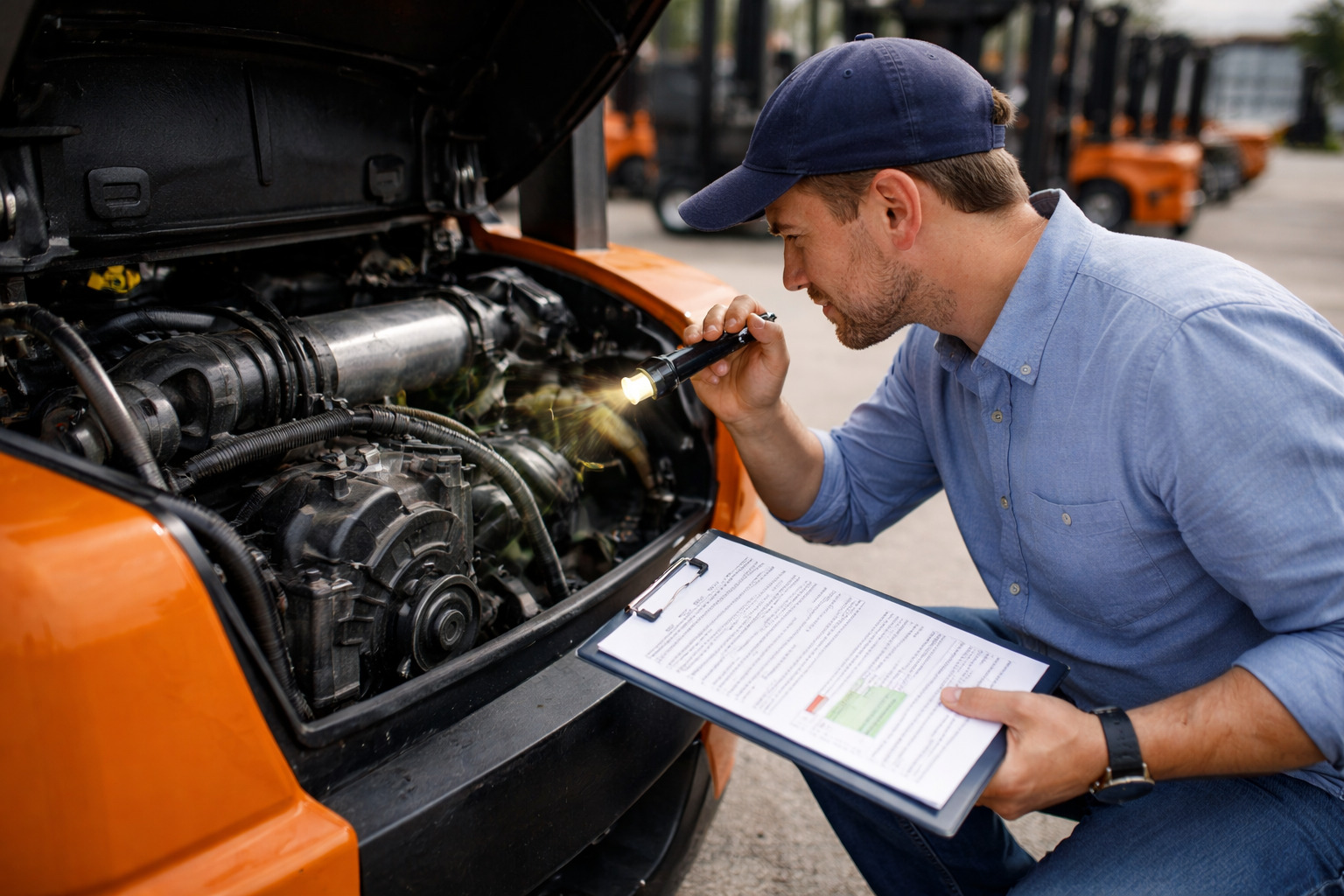
Skipping a proper inspection can turn a low-price forklift into a maintenance nightmare. Used forklifts naturally show wear, but not all wear is safe or repairable.
What To Check Before Buying
A hands-on review of key systems and visible wear indicators can reveal whether a used forklift is a smart investment or a liability.
- Mast and carriage condition: Cracks, chain stretch, or uneven movement can signal structural issues.
- Fork integrity: When buying new or used forklift for sale, look for worn heels, bent tines, or missing safety pins.
- Tire wear: Chunking or flat spots show how hard the truck was used and what surfaces it operated on.
- Hydraulic leaks: Cylinder seepage or jerky controls often mean upcoming repair bills.
- Powertrain performance: Cold-start reliability, smoke levels, or battery health are red flags depending on fuel type.
- Safety system function: Horns, lights, alarms, seat belts, and guards must all work per OSHA/NIOSH guidelines.
Mistake #3 — Buying Based Solely On Price
A low sticker price may seem appealing, but it often hides costly downtime, higher part failure rates, and poor long-term performance, especially on a used forklift for sale.
Why Value Beats Price
Total cost of ownership—not just upfront cost—should drive the decision.
- Lifecycle planning: A higher-quality forklift typically lasts longer with fewer unexpected repairs.
- Downtime costs: When a forklift is down, docks stall and workflows stop.
- Service support: Compare parts availability, technician response times, and warranty coverage.
- Brand reliability: Well-supported brands often offer stronger dealer ecosystems and faster turnaround.
Mistake #4 — Overlooking The Importance Of Testing
A forklift that performs well on a smooth dealer lot may struggle in the actual working environment. Real-world testing helps confirm fit.
Why On-Site Testing Matters
Testing under real conditions provides critical feedback and reveals handling, visibility, and comfort concerns.
- Site-specific challenges: Ramps, tight aisles, and rough flooring test the truck’s true capability.
- Operator input: Drivers can quickly assess how the machine feels, handles, and responds.
- Full-function test: Ensure the forklift performs safely and smoothly under both loaded and unloaded scenarios.
- Buy-in and safety: A machine that operators dislike can lead to increased error rates and accidents.
Mistake #5 — Underestimating Total Ownership Costs
Forklift ownership goes far beyond the purchase price. Maintenance, energy use, and downtime all contribute to overall cost.
Why Cost Planning Is Critical
Ignoring the full picture leads to budgeting surprises and reduced ROI.
- Preventive maintenance: Scheduled service is essential to keeping the machine safe and operational.
- Fuel or power usage: Internal combustion and electric forklifts have very different energy costs.
- Wear parts: Tires, forks, hydraulic seals, and batteries all have limited lifespans.
- Downtime expenses: Each hour a forklift is out of service can disrupt fulfillment and increase labor costs.
Mistake #6 — Buying From An Unreliable Dealer
The seller’s credibility can affect performance, safety, and long-term service quality. A dealer of a fork truck for sale is more than just a vendor—they’re a support partner.
Why Dealer Reputation Matters
A reputable dealer ensures transparency, fast support, and honest documentation.
- Service documentation: Request full maintenance logs tied to the unit’s serial number.
- Technician response: Ask how quickly field techs respond to breakdowns or emergencies.
- Parts availability: Confirm whether OEM parts are stocked locally or sourced with delays.
- Refurb quality: Clarify if reconditioning included mechanical work or just a cosmetic refresh.
Mistake #7 — Ignoring The Importance Of The Mast
The mast directly affects how and where a fork truck for sale can operate. Buying the wrong mast type can limit reach and cause safety issues.
Why Mast Specs Matter
Mast design impacts clearance, stacking height, and load handling at elevation.
- Duplex vs. triplex: Triplex masts allow higher stacking with lower collapsed height—ideal for tight spaces.
- Free-lift requirements: Essential for low-clearance areas like trailers or containers where raising the mast isn’t possible.
- High-lift capacity: Always verify rated capacity at full lift height, not just base-level specs.
- Inspection points: Watch for worn rollers or excessive play, which can lead to sway or mast instability.
Which forklift brand is known for being the most reliable?
Reliability is the outcome of solid engineering plus long-term support. Across U.S. fleets, Toyota is widely viewed as a reliability benchmark, backed by consistent build quality and a broad service network.
Other top-tier names—Crown, Hyster, Yale, Mitsubishi/CAT, Raymond, and Jungheinrich—also perform extremely well when matched to the right application.
The most reliable choice for a buyer depends on the environment, maintenance culture, and local dealer strength. A top-tier name with weak service coverage can be less reliable in practice than a mid-tier brand backed by a fast, competent dealer.
What does the 3-foot rule mean when operating a forklift?
The 3-foot rule is a simple pedestrian safety buffer: keep at least three feet of clearance between a moving forklift and any pedestrian or obstacle. If someone enters that zone, the operator should stop and re-establish space.
This matters during buying too. If a workplace has mixed pedestrian traffic, buyers should prioritize visibility, responsive brakes, mirrors or cameras, and clear audible/visual alerts.
What are the key dos and don’ts of forklift operation?
Even the best machine is unsafe in sloppy hands. OSHA requires that only trained, evaluated operators drive powered industrial trucks and that workplaces manage pedestrian traffic around them.
Do’s:
- Wear a seat belt and use overhead protection.
- Keep loads low while traveling.
- Sound the horn at blind corners and intersections.
- Perform pre-shift checks every day.
- Follow load charts and drive at safe speeds.
Don’ts:
- Don’t exceed rated capacity or lift unstable loads.
- Don’t raise/lower loads while moving.
- Don’t carry passengers unless the unit is designed for it.
- Don’t operate a truck with known defects or missing safety gear.
Quick Buyer Checklist
Before committing to any fork truck for sale, this checklist prevents most regret:
- Confirm capacity with a safety margin for heaviest loads.
- Match mast style to lift height, container work, and ceiling limits.
- When buying new or used forklifts, it should have a complete a full inspection—mast, forks, hydraulics, tires, powertrain, safety gear.
- Demo or rent the truck in the real work environment.
- Estimate 3–5-year ownership costs, not just purchase price.
- Verify dealer service strength and parts availability.
- Get operator feedback on comfort, controls, visibility.
Frequently Asked Questions
How long should a forklift typically last in regular use?
Most units can run for many years if they’re maintained on schedule. Lifespan depends heavily on workload, environment, and operator habits. Buyers should think in terms of hours and service history, not just age.
What paperwork should come with a forklift purchase?
A legitimate new or used forklift for sale usually includes proof of ownership, service records, and the data plate information. Missing documents can create headaches later. Buyers should ask for whatever history is available before signing anything.
What kind of maintenance schedule should be expected?
Forklifts generally need routine checks daily, plus planned servicing at set hour intervals. Skipping small services often leads to bigger repairs later. A buyer should confirm what the recommended schedule looks like for that model.
Are attachments easy to add later?
Many forklifts can handle attachments, but compatibility isn’t universal. Adding attachments can change handling and capacity in ways buyers don’t expect. It’s best to confirm fit and impact before assuming upgrades are simple.
What should buyers know about delivery and setup?
Delivery costs vary based on distance, truck size, and unloading needs. Some sites require special offloading equipment or access planning. Buyers should clarify who handles transport and setup before purchase.
Find the Right Forklift for Sale in Lauderdale Lakes, FL Today!
Reliable material-handling starts with equipment that matches the job, and Almeida Forklifts makes that search easier for businesses in Lauderdale Lakes, FL. From selecting the correct capacity to choosing the right mast and power type, every unit is backed by knowledgeable guidance and dependable support in Lauderdale Lakes, FL.
Explore available inventory, compare options confidently, and keep operations moving with a forklift that fits the site and budget—contact Almeida Forklifts in Lauderdale Lakes, FL, now to get a quote and schedule a demo!